By Edmund Chilaka
Once CNG4MARINE commercially commences, BGM-built marine CNG units will be positioned in strategic terminals and jetties to provide access to CNG-powered boats to refill their onboard cylinders – Layi Solesi.
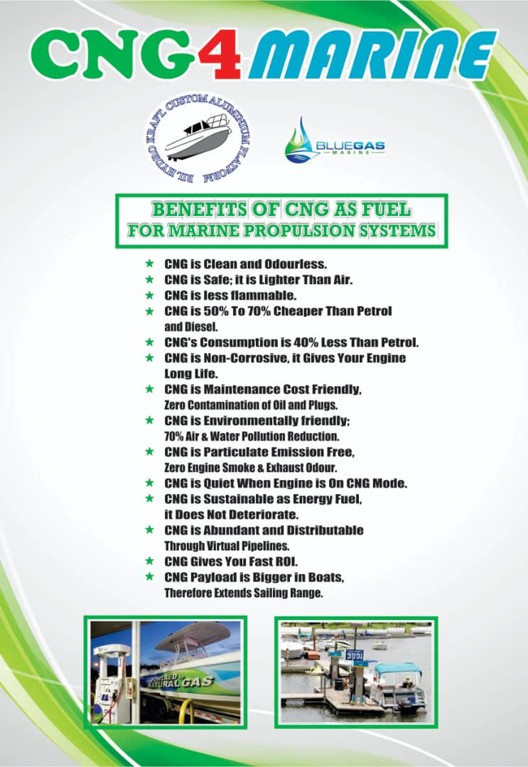
The government policy for the introduction of CNG-powered buses is to reduce reliance on conventional fuels for the operation of modal transport vehicles. Whereas the CNG-operated buses are aimed to lower road transport operating costs, another transport mode targeted by the policy is inland water transportation. The initiative is called CNG4Marine and envisages supplying retrofitted kits for operators of watercraft to switch from petrol and diesel to CNG as well.
Earlier in the week, the Presidential Initiative on CNG and Electric Vehicles (Pi-CNG & EV) delivered 20 additional high-capacity Compressed Natural Gas (CNG) buses to the Lagos Metropolitan Area Transport Authority (LAMATA) on Wednesday, September 30, 2026, to increase the existing fleet of 150 already operating in the public transport sector of Lagos State.
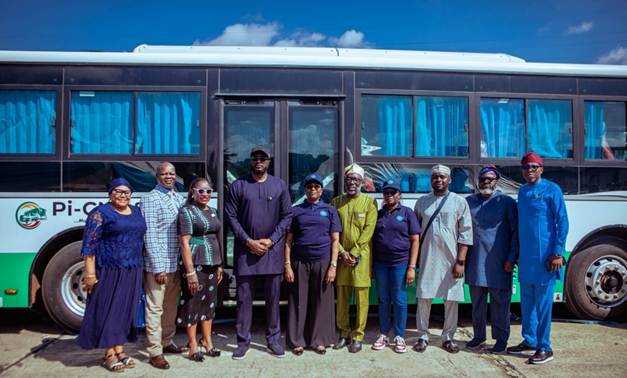
At the handover of 20 CNG buses to LAMATA in Lagos last week
Produced by IVM and TATA, the units were geared to meet the Federal Government’s October 1 target for Nigerians to begin seeing measurable reductions in public transportation costs through greater use of CNG and electric buses.
The Managing Director/CEO of LAMATA, Engr. Abimbola Akinajo, received the buses at the LAMATA headquarters stressing that they will provide commuters “more efficient, affordable, reliable, and sustainable public transportation”.
RIL Hydro Krafts Ltd is a niche operator in Nigeria’s Blue Economy subsector and the promoter of CNG4MARINE with affiliation to Blue Gas Marine Inc. In this interview Layi Solesi, the CEO of the firm, fielded questions to throw more light on the initiative and the timelines for the rollout of their services. Excerpts:
DDH: What is the main package RIL Hydro Krafts Ltd and Blue Gas Marine Inc (BGM) are offering Nigerian boat operators through the CNG4Marine initiative?
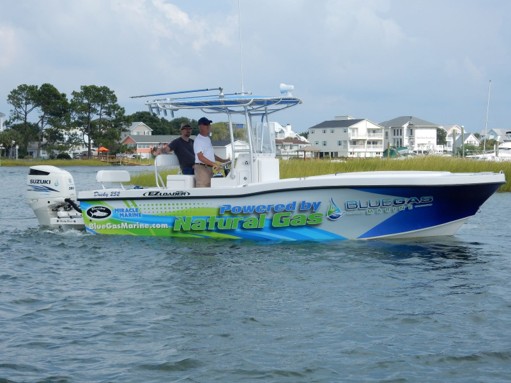
Solesi: The CNG4MARINE value proposition enables commercial boat operators otherwise called ferry operators and private boat owners to use natural gas in its compressed form, that is, CNG, as fuel to power their boat engines, without any modification to their engine internals, while the engines still retain their ability to use petrol alternatively. As you know, RIL Hydro Krafts Ltd and Blue Gas Marine Inc. USA, are in a strategic partnership relationship. This relationship is underlined by RIL Hydro Krafts Ltd role as the exclusive distributor of all Blue Gas Marine Inc products not only in Nigeria, but across West Africa.
DDH: Have you identified the operators you want to reach with this initiative, their characteristics and their modus operandi?
Solesi: Intentionally and strategically our launch focus is on outboard-motor powered boats. So, in terms of operators, commercial boaters are our focus. Their ferries are petrol outboard motor powered. As operators, they play a crucial role in public water transportation. The current initiatives by the Federal Government and the subnational governments to reduce fares particularly on public transportation platforms through CNG resonates very well with us.
DDH: What was the main aim of the event of 9th July 2025 in the CNG project which brought industry chieftains together?
Solesi: The forum was centred on LASWA’s aspiration as Lagos State’s water transportation regulator to transform its recently acquired medium-capacity ferries as well as the state’s legacy ferry fleets powered by petrol outboard motors into CNG-petrol hybrid powered ferries. So, the forum brought together operators, investors, financiers, and other sector stakeholders as well, towards charting a pathway to achieving LASWA’s goal. The event was headlined by the former CEO of PiCNG Engr Michael Oluwagbemi as special guest of honour. He communicated Mr President’s intention to ensure all modes of transportation that could use CNG are included in PiCNG’s mandate. He further committed that marine transportation sector would get the same support and benefit the road transportation sector got from PiCNG. Stakeholders were very excited and hopeful after his presentation.
DDH: What are the roles of stakeholders such as the Presidential Initiative on Compressed Natural Gas (PiCNG) and the RHKL/CNG4Marine in the value chain?
Solesi: In accordance with its mandate, PiCNG & EV as it is now called, is an enabling agency, the prime driver of the Federal Government’s CNG for Mobility Program underlined by the decade of gas initiative. The agency is in the forefront of promoting the adoption of CNG, including the liquified variant as an affordable, clean, safe and low emission alternative to the expensive conventional fossil fuel across Nigeria’s transport sector. Also included in their affordable and clean energy mandate are electric vehicles, thereby expanding the energy mix for Nigeria’s mobility eco-system. CNG4MARINE is RIL Hydro Krafts Ltd multi-functional value proposition that drives our advocacy, that is, our engagement with the Federal Government and its agency, PiCNG & EV, on the need to onboard the marine transportation sector on the Presidential CNG Initiative programme. Our advocacy also extends to sub-national governments endowed with waterways that people use for their daily commuting. Our robust partnership with LASWA is a solid case in point on public-private sector collaboration for the ultimate benefit of citizens. CNG4MARINE under our commercial value proposition enables us to provide the BGM CNG Hybrid Dual Fuel technology to ferry operators or boat owners who are desirous of integrating their boats with the capabilities to use CNG as a cheaper, cleaner, safer and emission-friendly alternative to petrol or diesel. At CNG4MARINE we also provide the quick-to-market CNG refuelling infrastructure that will enable CNG-powered boats to refuel their onboard CNG tanks. This is the BGM Marine Gas Units.
DDH: Who are the envisaged infrastructure investors?
Solesi: The history of Nigeria’s mobility CNG eco-system is still new, since the initial pilot by the NNPC-Nipco JV in Edo State. But it has been rapidly growing since the rollout of President Tinubu’s Presidential CNG Initiative. About $2b has been invested in the mobility CNG space. This investment has significantly been private sector-led. The investments have been across the post-feedstock value chain, that is CNG mother stations, daughter stations, auto CNG conversion workshops, and auto CNG conversion kits. Investors are still attracted to Nigeria’s mobility CNG market. Clearly these investors will certainly find the new marine CNG market appetizing. That said, access to capital in the inland marine sector is very low. My understanding is that there is inadequate knowledge of the sector, non availability of marine desks in these institutions and very low risk appetite as well. I think they are underestimating the daily urban water commuting traffic such as that of Lagos State and the inherent cashflow that abounds. A handful of financial institutions, to be charitable have in recent times been involved in financing some platforms and infrastructure projects, particularly in the Lagos inland water transportation sector. We welcome collaborative arrangements with these financial institutions towards providing capital access to boat operators who desire to retrofit their boats with the BGM-onboard CNG technology or investors who want to play in the refuelling infrastructure segment.
DDH: What does the plan involve to retrofit existing ferries and deploy CNG refuelling infrastructure across Lagos?
Solesi: This will have to involve a public and private collaborative arrangement if you are talking about across the waterways of Lagos. That arrangement is somehow being formed, it will start to unfold after the pilots.
DDH: How will hybrid marine technology reduce emissions, fuel costs, reduce ferry transport costs to increase ridership numbers?
Solesi: Indulge me, please, let me re-phrase your question. Can BGM Hybrid Dual Fuel Technology reduce emission, fuel costs, and boat fares? That is easy, CNG cuts green house gas emissions by over 30%, CNG price per SCM is significantly lower than petrol and diesel per litre. Now lower energy cost or OPEX should reduce naturally and lead to lower fares. It is easier to ensure relative lower fares to the benefit of commuters in the water transportation sector with minimal to zero enforcement, unlike what might be the discouraging experience of commuters in the road transport sector. There is a collaboration in the works towards achieving this objective.
DDH: On the question of safety protocols and regulatory frameworks, what is CNG4Marine doing to encourage CNG adoption by operators?
Solesi: Safety, standards, and regulation are very important to us and, in fact, embedded in CNG4MARINE. The marine environment is highly corrosive; hence the BGM CNG Hybrid Dual Fuel Technology is built with this in mind. The advocacy aspect of CNG4MARINE has been in the forefront of that. CNG4MARINE welcomes competition in this marine onboard CNG technology space, the more the merrier. That said, there must be zero tolerance for charlatans because one incident will be too many. Safety first, safety last. We are collaborating with stakeholders as regards that. We will leverage on what has been achieved in the auto CNG sector, juxtapose it with the marine sector and take it a notch higher. We assure sector stakeholders we are taking this extremely seriously.
DDH: Are the private sector boat and canoe operators factored into the plans for national roll-out of the initiative now or in the future?
Solesi: It’s a step-by-step game plan. Huge investments are required. As you know, the marine transportation environment is not for the faint-hearted. The Lagos inland water transportation market is the most burgeoning in the country, hence our collaboration with LASWA and PiCNG & EV to conduct our in-country pilot. The infrastructural, environmental, traffic, and safety conditions are suitable for the conduct of the CNG4MARINE in-country pilot precedent to formal launch of CNG4MARINE services.
DDH: What is the relationship between CNG4Marine Initiative and LASWA in terms of attaining joint objectives of reducing carbon footprint of the inland waterways sector in Lagos State?
Solesi: RIL Hydro Krafts Ltd under the auspices of its CNG4MARINE and LASWA are strategic partners for the good of the citizens of Lagos, Nigeria and humanity. Decarbonisation of the waterways of Lagos is a goal both organisations share.
DDH: What are the plans for refuelling of water crafts and the next milestone being awaited in your activities?
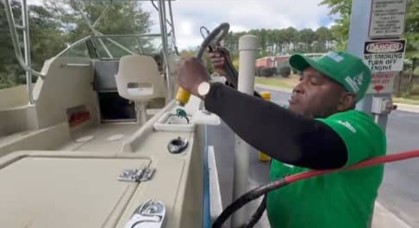
Solesi: Once CNG4MARINE commercially commences, BGM-built marine CNG units will be positioned in strategic terminals and jetties to provide access to CNG-powered boats to refill their onboard cylinders. As the eco-system scales up, we project an investment surge into fixed or floating dockside refuelling infrastructures.